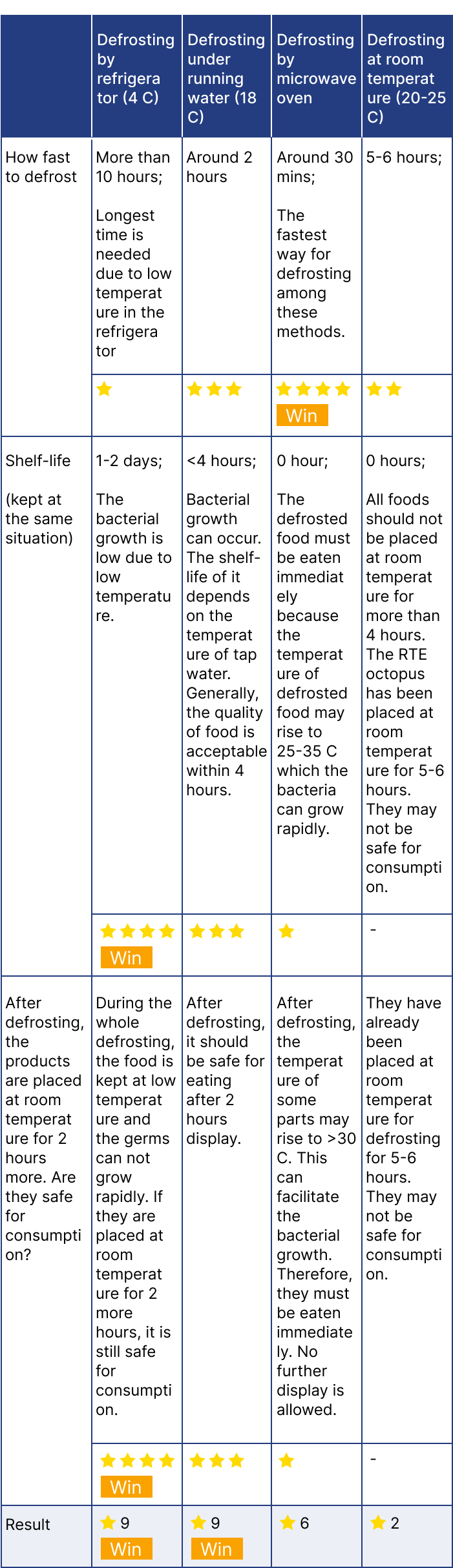
After three rounds of competition, the winners are the ways done by refrigerator and running water. Although the fastest way is to defrost by microwave oven, the safest way is to defrost by refrigerator. In fact, most food manufacturers choose refrigeration to thaw their foods, either cooked or uncooked. This is because the food is kept at low temperature and this can effectively slow down bacterial growth.
Among the above four defrosting methods, defrosting at room temperature is not recommended. We should avoid doing so. This is because the frozen food is placed at ambient temperature for a long time. Time for defrosting highly depends on the quantity needed to be defrosted. In some cases, more than 4 hours may be needed and it is not recommended. For the other three methods, we should pay attention on the following points.
Defrosting by refrigerator
- We need to plan ahead that what food will be cooked in the next day because of a long defrosting time, usually overnight.
- Food should be wrapped to prevent contamination.
- We should place ready-to-eat (RTE) food and non-ready-to-eat food at upper and lower compartments of refrigerator respectively.
- The defrosted food should be placed in refrigerator at all time until it is used or consumed.
- Food should be used or consumed within 2 days.
Defrosting under running water
- RTE food should be wrapped before putting in water to prevent contamination.
- Non-RTE food could be defrosted without wrapping, but thorough cleaning of equipment and utensil must be performed before and after to avoid transmission of bacteria to other food.
- Water should be kept running to facilitate faster defrosting.
- If the defrosted food is not used immediately, they should be wrapped and put in refrigerator.
Defrosting by microwave oven
- Food should be wrapped before putting in microwave oven.
- The defrosting should be divided into two phases. Food should be taken out for stirring or turning over to facilitate adequate and even defrosting.
- We should turn off the machine and wait for a few seconds before taking food out.
- Food must be cooked or consumed immediately because the temperature of some parts of the food may become higher than 30 C. Such warm temperature may facilitate bacterial growth in food.
To prevent bacterial food poisoning, don't re-freeze defrosted food.
Information source: Centre of Food Safety of Hong Kong Government
https://www.cfs.gov.hk/english/whatsnew/whatsnew_fsf/whatsnew_fsf_defrosting.html